

Ore processing is like separating the truly valuable parts from a pile of mixed “treasures.”
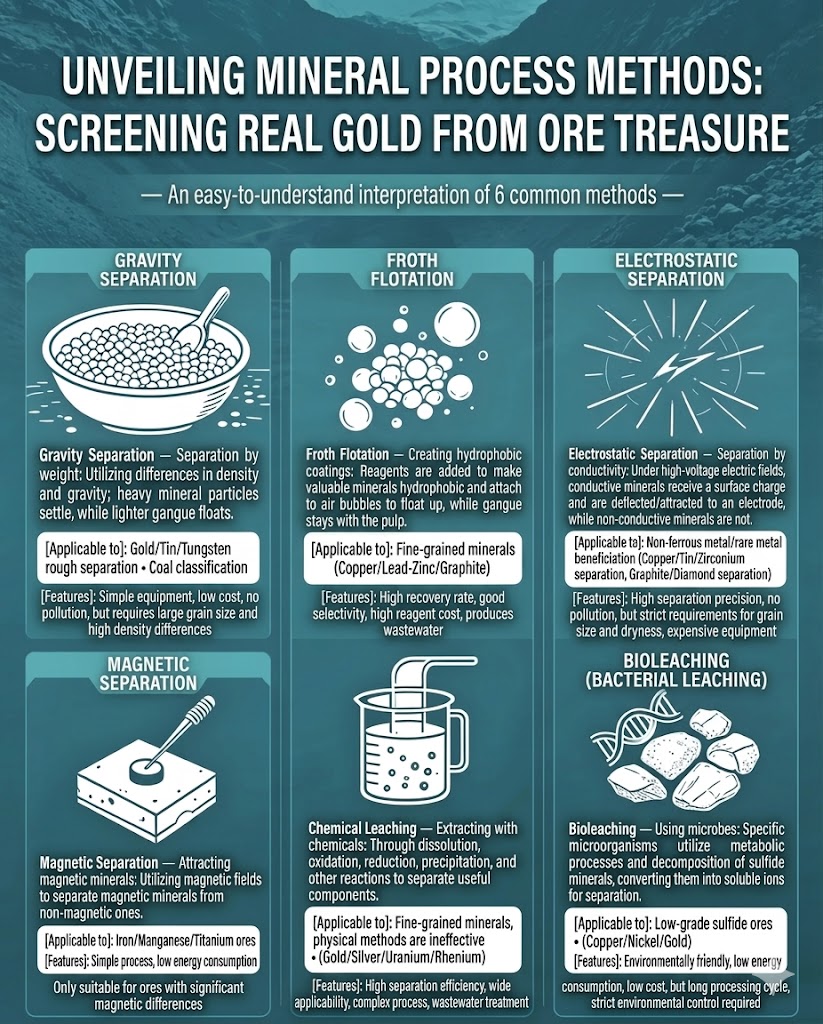
Gravity Separation – Separating by “Weight”
Principle: This method takes advantage of the difference in density between valuable minerals and gangue (impurities). Under the influence of gravity, water flow, or centrifugal force, heavier minerals sink while lighter impurities rise, much like how plump rice grains sink to the bottom while empty husks float to the surface when washing rice.
Applications: Suitable for processing coarse-grained ores with significant density differences, such as roughing of gold, tin, and tungsten ores, as well as coal washing.
Features: Simple equipment, low cost, and pollution-free. However, it requires significant differences in particle size and density.
Froth Flotation – “Coating” Minerals to Float
Principle: By adding special reagents, the surface of valuable minerals is made hydrophobic (water-repellent), allowing them to attach to air bubbles and rise to the surface as foam (concentrate), while gangue minerals remain in the slurry due to their hydrophilicity.
Applications: Suitable for fine-grained minerals, especially those with small specific gravity differences or complex embedding structures, such as copper, lead-zinc, and graphite ores.
Features: High separation efficiency and strong selectivity. However, reagent costs are relatively high, and wastewater treatment is required.
Magnetic Separation – Using a “Magnet” to Extract Magnetic Minerals
Principle: This method utilizes differences in magnetic properties. Under a magnetic field, magnetic minerals (e.g., magnetite) are separated from non-magnetic minerals, similar to using a magnet to pick up iron nails.
Applications: Mainly used for iron ore processing, as well as for purifying magnetic minerals like manganese and titanium ores.
Features: Simple process, low energy consumption, and pollution-free. However, it is only applicable to ores with magnetic differences.
Electrostatic Separation – Separating by “Conductivity”
Principle: This method exploits differences in mineral conductivity. In a high-voltage electric field, highly conductive minerals (e.g., metallic minerals) discharge quickly and are attracted or repelled by electrodes, while poorly conductive minerals (e.g., gangue) remain in place, achieving separation.
Applications: Suitable for the concentration of non-ferrous and rare metals, such as copper, lead, and zinc concentrate purification, as well as the separation of non-metallic minerals like graphite and diamond.
Features: High separation accuracy and pollution-free. However, it requires strict control of particle size and dryness.
Chemical Processing – Extracting with “Chemical Magic”
Principle: Through chemical reactions, valuable minerals are converted into soluble forms. The desired components are then separated via filtration, crystallization, or extraction and subsequently reduced back into usable minerals.
Applications: Suitable for ores with extremely fine embedding that cannot be effectively separated by physical methods, or for low-grade, refractory ores, such as gold and silver extraction, as well as rare metals like uranium and thorium.
Features: High separation efficiency and wide applicability. However, costs are high, and chemical wastewater and waste residues are produced, requiring environmental treatment equipment.
Post time: Jun-03-2026


